Neighbor, Friends and Memories
 By Darol Dickinson
January 27, 2026
I’m not sure why I’m spending several hours on this article, but I can’t get the past off my mind. I was there. I saw—and still see—it happening. My grand kids did not see this. They have no clue about the world that I and millions more came from. It was a world filled with calluses, tired bodies, poor nutrition, questionable education, shame, uncertainty—and pride in independence.
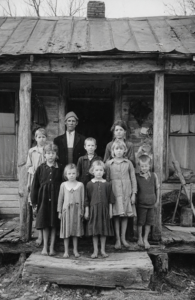 Black and White photo of hillbilly family.
In the 1940’s, I didn’t know anyone who knew a millionaire. We mostly thought the local banker was the richest guy. Of course that’s not the case. He may have had the most greenbacks, but back then a small farm would have been more valuable than the bank.
Few people in mid-century America planned or expected to attend college and get a degree. Volunteering for military service was a more economical way to get an education. That guaranteed a small paycheck, food, shelter, and a learning experience which also came with the chance to be killed.
My dad came home from the US Army after a near-death experience at Fort Hood. I was born ten months later. His Military Disability Retirement gave him a pension of $34 a month for the rest of his life.
After the war, Dad started a small farm and dairy in Texas. He had five cows and tied them by the road on a 20’ chain to eat ditch grass. Every morning and night he led them in for milking, then back to another place along the ditch for new grass. He hand-milked the cows and sold their fresh milk in glass slim-necked bottles
When I was old enough to be trustworthy, Mom drove around our little town in a 1946 two-door coupé. My job was to run milk up to the customer’s door and pick up empty bottles from the previous delivery. We did not have USDA looking over our shoulder, so it was easy to make a profit. People were healthier back then without thousands of government sanitary regulations and licenses.
Everyone had a garden, chickens, livestock, and of course a work ethic. As the chickens were consumed, broody hens set on enough eggs to hatch several dozen replacements every summer—if the snakes didn’t get them first.
Everyone also had a root cellar—a traditional, earth-sheltered space about six feet deep with dirt for the roof. These eco-friendly refrigerators were economical to make and used the good earth to preserve food naturally. Key to their success was maintaining constant 90-95% humidity, darkness, and cool temperatures. Good ventilation vented ethylene gas and prevented spoilage. Without electricity, the root cellars stored and extended shelf life for almost everything we ate: canned goods as well as fresh fruit, root vegetables like potatoes, carrots, onions, and sweet potatoes. Oh, yes, and smoked hams, bacon, and pork cracklins.
Our food was seldom store-bought. Out past the garden, Dad planted peanuts, melons, black-eyed peas, and we had fruit and pecan trees. From the dairy and woods, we had milk and ice cream, wild mustang grapes, and wild collard greens, which I hated. Dad never sprayed anything on the plants. We kids just hoed out the weeds by hand.
In the fall, everyone I knew picked cotton. That wasn’t a stereotypical job just for Blacks. It was for anyone who had a work ethic and needed money—which everyone I knew did. The field owners paid pickers by the pound. The more you picked, the more you got paid. To help our families, we little kids had to pick and earn whatever we were able to.
Mom made me a little cotton sack from one of Dad’s old pant legs; it held only about three pounds. One tall Black man had a huge sack that dwarfed mine: it was about 15’ long. He was much faster than the rest of us, who couldn’t come close to him in pounds picked. We admired his skill and laughed with him and his great humor in the cotton patch.
Mom and Dad voted in every election. As late as the ’forties and ’fifties, states could still levy a poll tax as a prerequisite for voting. Dad didn’t complain a lot, but the poll tax cost 32 cents apiece for Mom and him to vote. They always paid the tax so they could vote in the next election—but they didn’t like it.
We didn’t think of ourselves as poor white trash. In fact, I don’t recall thinking at all about wealth or status. But faith and religion were always part of our life. We attended a Baptist Church and followed Dad’s example. He said you always put something into the offering plate when it goes by, no matter whether the preacher’s message was good or not. He was dedicated by example. He always put in a dollar.
Some neighbors that we considered poor lived just down the road. They went to town about once a month in an old car that never ran. Maybe they didn’t have money for gas, because the whole family would push the car on level ground—and even up hills, then jump in and ride down. I’m sure they took a whole day to go to town three miles away. Their car was usually full of firewood, eggs, and things to barter that they had made or harvested from their little piece of land.
The first thing these neighbors did in town was go to the local feed store. The kids would run all over looking for mixed-grain chicken feed. It was sold in cloth sacks with a flower print or some other colorful design. In time, these sacks showed up as the boys’ shirts or girls’ dresses. Like most other wives, their mother was necessarily a seamstress who made all her kids’ clothes because very few clothes were store-bought.
We did not know these neighbors well, but everyone knew they were poor. If and when the kids went to school, they took a small sack with some food from home. It wasn’t much, but they didn’t even have 15 cents for hot lunches. Some accused the boys of stealing other kids’ food, but I can’t be certain of that.
One day Mom took some food over to these poor neighbors. The wife was insulted rather than grateful. She made it plain that their family did not take charity. They could take care of themselves without pity from others. Although they were evidently hungry, they were wonderfully proud of not being beggars, tramps, hobos, or panhandlers. They would rather do without than depend on welfare. Mom and other well-intentioned folks could never force them to take charity. They had their pride. The shame of being a parasite on welfare would have been unbearable.
Our neighbors worried about more than self-degradation, the loss of dignity, and especially the fear of transmitting dependency across generations. They worried that their children would normalize welfare and become hopelessly, almost genetically, dependent. They weighed the result of relying on government charity and decided it was worse than hunger.
Fast forward to 2026. We find little public humiliation in transactions using EBT cards for food and cash. Government chits have raised routine transactions beyond anxiety and completely destroyed a sense of being patronized, of being “othered.” Our old neighbors refused to take that path.
What has changed in less than 100 years?
Today, government programs have pirated legitimate, private charity, disguising it as welfare and universal human rights. These programs have encouraged people to apply for grants and help of all kinds—including cashing checks for long-dead relatives and paying for scams. What’s the result?
Although some folks truly need help, today about a third of people living in the USA get paid for just living, breathing, and doing nothing. Many are shameless. Most are so dependent they couldn’t exist without government support.
How long will people working daylight-to-dark Bible hours stand for rewarding able-bodied non-achievers who are perfectly capable of doing a day’s work? Those parasites are sucking hard-earned income from real Americans. They have no incentive to go back to the fierce independence of our neighbors. The USA would do well to revive our neighbors’ old, strong sense of pride. Please, shame, return!
Some who are more knowledgeable than I am say the whole national debt could be eliminated if the government cut out welfare scams and undeserved benefits. We’ll see.
If every family taught its kids strong convictions and a serious work ethic, we could raise proud, independent citizens again. New generations with our old neighbors’ morals wouldn’t even know what EBT stands for, much less depend on it for total survival.
[BIO: Darol Dickinson is general manager of Dickinson Cattle Co. LLC near Barnesville, Ohio. Darol has judged major cattle shows including the Houston Livestock Show. He writes articles, speaks at cattlemen s events, does livestock judging clinics, and talks the animal circuit.
The diversified ranch involves public narrated bus tours, Certified Texas Longhorn Beef, seasonal hunting, year round marketing of registered cattle, and a private gated development called Longhorn Hideaway, for those who enjoy a quiet ranch life where the Longhorns roam.
Darol has illustrated 4 books and written several. His autobiography is Fillet of Horn which has been on the Fairview best seller list for 14 years. His how-to book on Livestock Photography sold out 5 printings. The Color of Horses book with 34 color illustrations is now in the 7th printing. Darol s new non-fiction book is Horn Stew.]
© 2026 Darol Dickinson – All Rights Reserved
E-Mail Darol Dickinson: darol@texaslonghorn.com