


 By Amil Imani
January 6, 2026
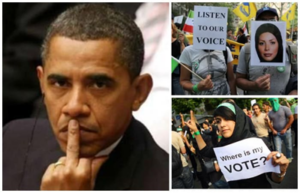
In June 2009, the streets of Tehran were flooded with millions of protesters in what became known as the Green Movement. Following a disputed election that kept Mahmoud Ahmadinejad in power, the world watched as Iranian citizens – led by youth and women – demanded “Where is my vote?” The crackdown that followed was brutal: snipers fired from rooftops, and the image of Neda Agha-Soltan bleeding to death on the pavement became a global symbol of the regime’s cruelty.
However, from the White House, the response was one of “strategic caution.” For days, President Barack Obama remained largely silent, refusing to “meddle” or take a side. Iranian activists alike viewed this as a historic betrayal. By the time Obama issued a stronger condemnation, the regime had already gained the upper hand. Years later, Obama himself admitted in an interview that he made a mistake, stating, “Whenever we see a glimmer of hope, of people being able to have a voice, we should be public about it.”
The motivation for this silence, according to investigative journalists like Jay Solomon in The Iran Wars, was a desire to protect a long-term goal: a nuclear deal with the Islamic Republic. To achieve this, the administration sought to assure Supreme Leader Ali Khamenei that the U.S. was not seeking “regime change.”
 Central to the falsehood of this era is the National Iranian American Council (NIAC). While NIAC describes itself as an advocacy group for Iranian Americans, it is actually a lobby for the interests of the Islamic Republic in Washington.
The NIAC has been consistent in its advocacy for policies that benefit the Tehran regime, most notably the lifting of sanctions without requiring human rights reforms. During the 2009 protests, while the regime was killing demonstrators, NIAC’s leadership was involved in amplifying the regime’s narrative that U.S. support for the protesters would be “counterproductive” and “dangerous.”
Evidence of NIAC’s deep involvement surfaced during a 2008 defamation lawsuit the group filed against Hassan Daioleslam. The lawsuit backfired significantly. During the discovery process, internal documents and emails were revealed that led a federal judge to sanction NIAC for withholding and altering records. The court eventually ordered NIAC to pay over $180,000 in legal fees to the defendant. The documents uncovered showed extensive communication between NIAC’s leadership and Iranian officials, including Javad Zarif, who would later become Iran’s Foreign Minister. These revelations proved beyond any dount that NIAC acted as an unregistered foreign agent, moving the needle of U.S. policy in favor of a regime that oppresses its own people.
The consequences of this “appeasement” policy have now manifested in a direct path toward regional instability and potential nuclear escalation. According to analysis from the American Center for Law and Justice (ACLJ) and JFeed, the structural flaws of the 2015 Nuclear Accord – specifically its “sunset clauses” and the lack of restrictions on ballistic missiles – effectively subsidized the Iranian regime’s military expansion. By unfreezing billions in assets and lifting secondary sanctions, the U.S. provided the financial “fuel” for the IRGC to build the very drone and missile infrastructure used in recent direct conflicts with Israel.
The shift from the Obama-era deal to today’s “detonation” point is a straight line: a policy that prioritized a temporary nuclear pause over dismantling a terrorist network. Fifteen years after the Green Movement, we can clearly observe a pattern of “betrayal” extending into the Biden administration, where continued sanctions relief is seen not as a tool for peace, but as a direct contribution to a “Nuclear Armageddon” scenario in the Middle East.
While Iranians were being tortured in the Kahrizak prison, President Obama was engaged in a secret correspondence with the man ordering the crackdowns. It is now a matter of historical record that Obama sent at least four personal letters to Supreme Leader Ali Khamenei.
These letters, sent in 2009, 2011, 2012, and 2014, were intended to build “mutual respect” and “trust.” However, the optics were devastating for the Iranian freedom movement. To the protesters on the street, the President of the Free World was treating their oppressor as a legitimate partner. This diplomatic outreach culminated in the 2015 Joint Comprehensive Plan of Action (JCPOA).
The deal provided the Islamic Republic with billions of dollars in sanctions relief and returned frozen assets. This “infusion of cash” was used to fund the IRGC (Revolutionary Guard) and proxy wars in Syria, Yemen, and Lebanon. From this perspective, the administration prioritized a temporary freeze on nuclear enrichment over the permanent aspiration of 80 million Iranians for liberty.
The factual timeline of 2009 to 2016 paints a picture of a U.S. administration that viewed the Islamic Republic as a stable state to be negotiated with, rather than a revolutionary regime to be confronted. By empowering “reformists” who were still beholden to the Supreme Leader, and by relying on the advice of groups like NIAC, the Obama administration chose a path of conciliation.
For the “Freedom Fighters” of the Green Movement, this was not just a policy disagreement; it was an abandonment. They entered the streets expecting the world’s greatest democracy to stand behind them. Instead, they found that the leader of that democracy was busy exchanging letters with the very man who was ordering their arrest. The result was a solidified regime, an empowered IRGC, and a generation of Iranians who learned that in the game of global power, their lives were secondary to the “big deal.”
© 2025 Amil Imani – All Rights Reserved