The Role of Congress
 By Paul Engel
June 30, 2023
- Of the three branches of the federal government, most of the powers are delegated to the legislative.
- As the representative branch of government, Congress is also where the representatives of both the people and the states are supposed to enact their will.
- With Congress exercising most of the powers delegated to the United States, it’s important that we hold our representatives accountable to their oaths to support the Constitution.
When I started studying the Constitution, I was struck both by how much I had not been taught in school, and how much of what I was taught was wrong. Based on the questions I’ve been asked and the assertions that have been presented to me, a lack of knowledge about the Constitution is almost universal in America. As I watch news coverage, politicians, pundits, and everyday people make claims about what the different parts of government can do, can’t do, or is required to do, it has become obvious that a basic understanding of how the United States government is organized is not only needed, but missing. So I’m starting a three-part series explaining the roles of the three branches of government. We’ll start where the Constitution starts, with the legislative branch.
One of the most common misunderstandings about the federal government is that we have three co-equal branches of government. As usual, the best lies have a kernel of truth in them. So while it’s true that the federal government has three branches, they are not equal. Whether you measure by how much space is dedicated to that branch or their list of powers, Congress is by far the most powerful branch of the federal government. Remember the grievance we were all taught was the reason we declared independence.
For imposing Taxes on us without our Consent
Or, as it’s more commonly referred to, “Taxation without representation”. This is why so many of the powers delegated to the United States are placed in the hands of the representative branch of government.
All legislative Powers herein granted shall be vested in a Congress of the United States, which shall consist of a Senate and House of Representatives.
U.S. Constitution, Article I, Section 1
What’s the legislative power that is vested in Congress?
Capable of enacting laws
Legislative, Webster’s 1828 Dictionary
So all the power of enacting laws is vested in Congress, and only Congress. What does that say about all those regulations coming out of the executive branch or the “case law” coming out of the judicial? We’ll talk more about those issues as we cover those branches, but sufficient to say that, if it’s a “law” that did not come from Congress, then it’s not a law.
This Congress is made up of two houses, a Senate and a House of Representatives. Why two houses? That’s an interesting story.
Two Houses of Congress
There are two reasons we have a bicameral, or two house Congress. The first is representation. The Constitution is the product of a number of compromises. One of them had to do with representation between the states. Under the Articles of Confederation we had only a single house in Congress, and that was the original plan for the Constitution as well. It should be no surprise that the larger states wanted representation based on population. This didn’t sit too well with the smaller states, since they would have less representation in a Congress formed that way. The smaller states wanted equal representation, but the larger states didn’t like that, because then the people in those states would have an outsized impact on federal legislation. Connecticut delegate Roger Sherman proposed a bicameral legislature, with one house apportioned by population and the other apportioned equally between the states.
The other reason for a bicameral legislature is something unique to the United States. The preamble to the Constitution reads:
We the People of the United States, … do ordain and establish this Constitution for the United States of America.
While the people ordained and established the Constitution, they did not do it directly.
The Ratification of the Conventions of nine States, shall be sufficient for the Establishment of this Constitution between the States so ratifying the Same.
U.S. Constitution, Article VII
Only the states could ratify the Constitution and, according to Article V, only the states could amend the document. Which means one of the unique things about the United States is that both the people and the states have a vested interest in the government of the United States, and should have a say in any legislation. Originally, that was the case, but that changed over a century ago.
The Senate
The Senate of the United States shall be composed of two Senators from each State, chosen by the Legislature thereof, for six Years; and each Senator shall have one Vote.
U.S. Constitution, Article I, Section 3
Why were members of the Senate appointed by the legislatures of the states? Because their purpose was to represent the states in Congress. That is also why each state gets the same number of Senators, so the states would have equal representation in the Senate. That was, until 1913.
The Senate of the United States shall be composed of two Senators from each State, elected by the people thereof, for six years; and each Senator shall have one vote.
U.S. Constitution, Amendment XVII
In 1913 the states ratified the Seventeenth Amendment, which changed the representation in Congress. Now the Senators are no longer appointed by their state’s legislature, but elected by the people. This means the states no longer have any say in federal legislation, and the Senate is now, effectively, just another House of Representatives.
The House of Representatives
The House of Representatives on the other hand, was always meant to represent the people.
The House of Representatives shall be composed of Members chosen every second Year by the People of the several States,
U.S. Constitution, Article I, Section 2, Clause 2
Not only have the members of the House always been chosen by the people, they are apportioned to the states based on their population.
Representatives and direct Taxes shall be apportioned among the several States which may be included within this Union, according to their respective Numbers,
U.S. Constitution, Article I, Section 2, Clause 3
So we started out with this beautiful balance of representation: Each of the two Senators equally represented their state and each member of the House was to represent no more than 30,000 people.
The Number of Representatives shall not exceed one for every thirty Thousand, but each State shall have at Least one Representative;
U.S. Constitution, Article I, Section 2, Clause 3
While the change in the state’s representation was changed by the Seventeenth Amendment, the change in the number of people a member of the House represents comes from nothing more than the neglect of Congress.
Differing Powers
Another way we can see the different roles the two houses of Congress have is by looking at how the powers are shared between them.
All Bills for raising Revenue shall originate in the House of Representatives; but the Senate may propose or concur with Amendments as on other Bills.
U.S. Constitution, Article I, Section 7, Clause 1
As often as we like to complain about the IRS or that the President raises or lowers taxes, it’s actually the House that drafts the bill to do so. Compare that with the powers delegated to the Senate.
He shall have Power, by and with the Advice and Consent of the Senate, to make Treaties, provided two thirds of the Senators present concur; and he shall nominate, and by and with the Advice and Consent of the Senate, shall appoint Ambassadors, other public Ministers and Consuls, Judges of the supreme Court, and all other Officers of the United States, whose Appointments are not herein otherwise provided for, and which shall be established by Law:
U.S. Constitution, Article II, Section 2, Clause 2
While the decision about taxes starts in the House, treaties and appointments are made with the advice and consent of the Senate. This is often misrepresented as “The President nominates and the Senate confirms”, but that is not what the Constitution says. We’ll talk more about this in the article about the President, but for now please remember that the Senate is supposed to work with the President on these things.
The other difference between the powers of the two houses has to do with impeachment.
The House of Representatives … shall have the sole Power of Impeachment.
U.S. Constitution, Article I, Section 2, Clause 5
Only the representatives of the people have the power to impeach, or accuse, a member of conduct worthy of removal from office. Once the House has impeached someone, it’s up to the Senate to try the impeachment.
The Senate shall have the sole Power to try all Impeachments.
U.S. Constitution, Article I, Section 3, Clause 6
So it takes the representatives of both the people and the states to remove someone from office. The members of Congress are also privileged from arrest in certain circumstances.
The Senators and Representatives … shall in all Cases, except Treason, Felony and Breach of the Peace, be privileged from Arrest during their Attendance at the Session of their respective Houses, and in going to and returning from the same; and for any Speech or Debate in either House, they shall not be questioned in any other Place.
Article I, Section 6, Clause 1
In general, a member of Congress cannot be arrested while going to, returning from, or attending a session of Congress. There are exceptions made for treason, a felony, or breach of the peace. And as much as some may want to, nothing they say in either house can be held against them.
Conclusion
I don’t have the room to review all of the powers delegated to Congress in Article I, Section 8, but it is a long list with 17 separate clauses. If you would like me to do a separate article on those powers, let me know.
The reason we have three separate branches in the government of the United States is for separation of powers. The Framers of the Constitution understood that power concentrated in the hands of a few was dangerous. It also explains why when one branch of government infringes on the powers of another branch, it’s a serious danger to the republic. There are situations where Congress has claimed the investigative power of the executive branch. That’s not to say Congress has no investigative power, but only when it’s for a legislative purpose. More often than not though, what Congress has done over the decades is hand over their legislative power to the executive. They do this by making vague laws, then claiming to empower those in the executive branch to fill in the details with regulations. However, the Constitution does not give Congress the power to delegate its duties.
The members of Congress are the employees of the people, and it’s about time we remind both the Congressmen and the people of that fact. As the representative branch of government, it’s the duty of Congress to represent the people and the states, not just their donors or advocacy groups. If we wish to have a functioning republic, it’s up to We the People to not only learn that lesson, but to hold our elected employees accountable to it.
I hope you found this brief discussion of the role of Congress helpful. I look forward to the articles on the President and the Judiciary in the next few weeks.
© 2023 Paul Engel – All Rights Reserved
E-Mail Paul Engel: paul@constitutionstudy.com
 By Cliff Kincaid
 by Peter Falkenberg Brown
 Since you want those things, then it becomes clear that YOU don’t want to be dominated by a dictator class of oligarchs. You don’t want anyone coming into your home and saying, “You can’t read that, say that, watch that, do that, eat that, or do any of the things you want to do, because, too bad for you, but we’re in charge!”
 by Lee Duigon
 By Coach Dave Daubenmire
 Frosty Wooldridge
 That’s a taste of the good times while hiking, backpacking, rafting, canoeing or camping. It’s your connection with the wilderness. On long distance bicycle tours, another kind of connection to the Natural World encompasses your spirit. For months on social media, I followed Canadian Arie Hoogerbrugge across Canada, America and now into Mexico. I followed senior citizen Lee Rogowski on his journey from Key West, Florida to northern most part of Maine. One man is young and vibrant. The other is old, overweight, with a heart condition and used an E-bike to cover thousands of miles.
 By George Lujack
 By Bradlee Dean
 by Servando Gonzalez
 By Kelleigh Nelson
 By Dr. Marlene McMillan
 By: Devvy
 by Rolaant McKenzie
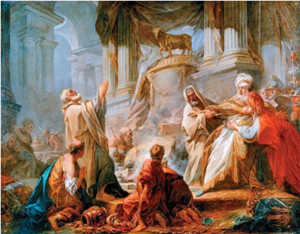 Jeroboam Sacrificing to the Golden Calf by Jean-Honoré Fragonard (April 5, 1732 – August 22, 1806)
 By Rob Pue
 By Pastor Roger Anghis
 By: Amil Imani
 By Sidney Secular
 By Michael Peroutka
 Andrew Wallace
 by Lee Duigon
 And this “woke” crap of placing pornographic books into our grade schools with “drag queens” putting on shows is beyond “stupid.” It’s immoral, unethical and downright sickening.
 By Glynn Adams
 The plot to force untested and toxic vaccinations on the entire world comes from the WHO, and is being promoted by Biden.
 By Paul Engel
 What do you think it will be like in 2050 with an added 60 to 80 million more immigrants and their offspring? Why won’t any of the top people on “Meet the Press”, “Face the Nation”, “60 Minutes”, “National Public Radio” or “Public Broadcasting Systems” interview anyone raising their voices as to what our entire civilization faces?
 By J.W. Bryan
 Panem’s ruling elite and wealthiest families comprised the residents of the Capitol. They lived in decadent ease, entertainment, and luxury. They dressed gaudily and ate sumptuously of the most exotic and richest foods.
 By Lewis Brackett
 By Jeffery Dover
 Shameful conduct by the House was disgraceful. It disregarded its rules and abandoned fair and proper procedures, leading to a compromised and unfair investigation. The House attempted to pass 20 articles of impeachment against Ken Paxton in less than 72 hours. Such an accelerated timeline undercuts the thoroughness and legitimacy of the proceedings, leaving no room for proper examination of the evidence or due process.
 Legal immigrants over the past couple of decades have declared the opposite of what is true – especially those who belong to the political party, Islam.[2] The Democrat/Communist Party USA is right along-side them. Legal immigrants from other countries (not all, of course) demand WE bow to THEIR demands. No saying the Pledge of Allegiance because it’s too offensive. In God We Trust in court rooms is offensive. If you’re Caucasian, you’re oppressing me and the list goes on.
 Flag Day was last Wed. In an absolutely SICKENING display of disrespect for our American flag, the illegitimate career criminal in the WH authorized putting a flag in the center with OUR American flag on each side to celebrate sexual deviants and the “trans” cult. A desecration of OUR White House.
 by Lee Duigon
 By Kathleen Marquardt
 Think about it. Almost everything you read/hear in mainstream and social media, in schoolbooks, even in “juried” scientific and medical papers is a lie. Wrap your head around that – you don’t need a virtual reality machine; your brain has been programmed to be one. And all this was put into overdrive once the first Intergovernmental Panel on Climate Change (IPCC) was released. (note: it was put together by great and no-so-great climate scientists around the world. But before it was released, it was “edited” to go from: saying “at worst humans may have some negative impact on our atmosphere, but very little – at most, to: we are destroying not only the atmosphere but also the water and land – and everything existing on earth.) A good number of those original authors asked to have their names removed.
 By Dennis Lintichum
 In
In  accessories to this genocide record is
  Pfizer knew their “vaccine” was killing people.
 By Steven Yates
 By Kat Stansell
 By Andrew Wallace
 “Just as it is not unique to Germany, in fact, eugenics was first promoted by the British (
 By Attorney Rees Lloyd
 When Arabs, a collection of backward, nomadic warrior tribes who did not even have a fully developed scripted language, conquered sophisticated cultures such as Egypt, Syria, Persia, and the Byzantine Empire, they took control over some of the world’s largest centers of accumulated knowledge. To claim that there was an “Islamic Golden Age” is like saying a group of savages storming into the world’s largest libraries, murdering all the librarians, and then claiming to have written all the books there, gives credit to this myth. Islam’s much-vaunted “Golden Age” was in fact just the twilight of conquered pre-Islamic cultures, an echo of times past. In all honesty, Islam’s trophy to human civilization is and always has been, Islamic terrorism.